SUNDAY BLAST FOR EMIRATES TEAM NEW ZEALAND
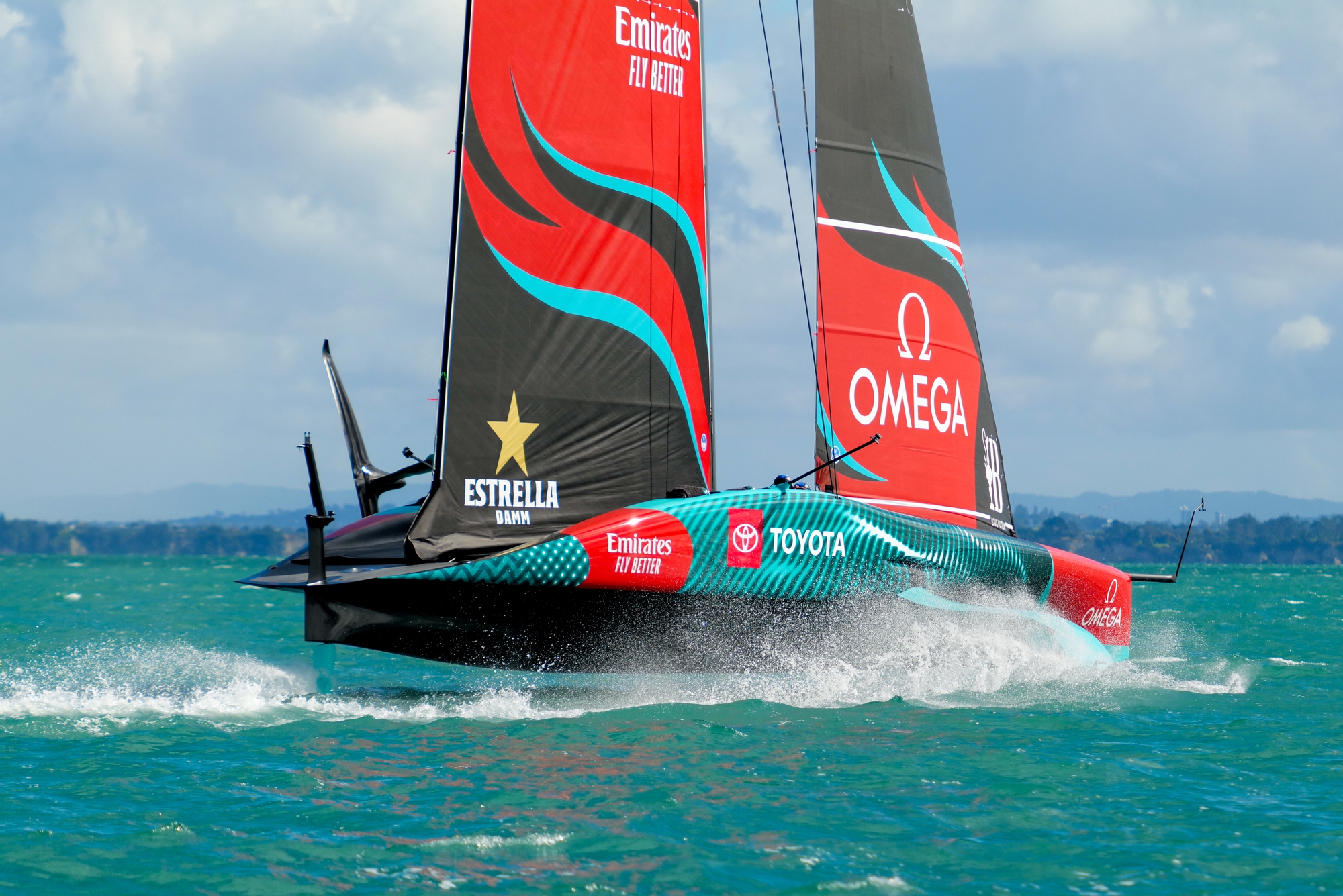
They couldn’t resist it and who could blame them? Emirates Team New Zealand took to the Hauraki Gulf on Sunday in their brand new AC75 with the sailors itching to get going and push fast through the commissioning phase. No nonsense as always, the day was efficient, despite the team leaving the mainsail inflatable bag that sits between the mainsail skins, back on the dock and having to send a chase boat in to get it.
Once up and flying, this was all about systems evaluation and power delivery from the cyclors who will start the long process now of fine-tuning and evolution to extract the absolute maximum from the platform. Seated in the back two pods, the ‘pain lockers,’ the cyclors are almost invisible, beautifully aero and moulded into the deck shape with a fully functional brief – pedal and pedal hard. Hard yards to come as the boat is worked up before making the journey to Europe at the end of the New Zealand summer. Meanwhile, sail shape was being acutely analysed with the customary LiDAR cameras mounted either side as the Performance Team looked to decipher and decode what makes the new generation AC75, fast.
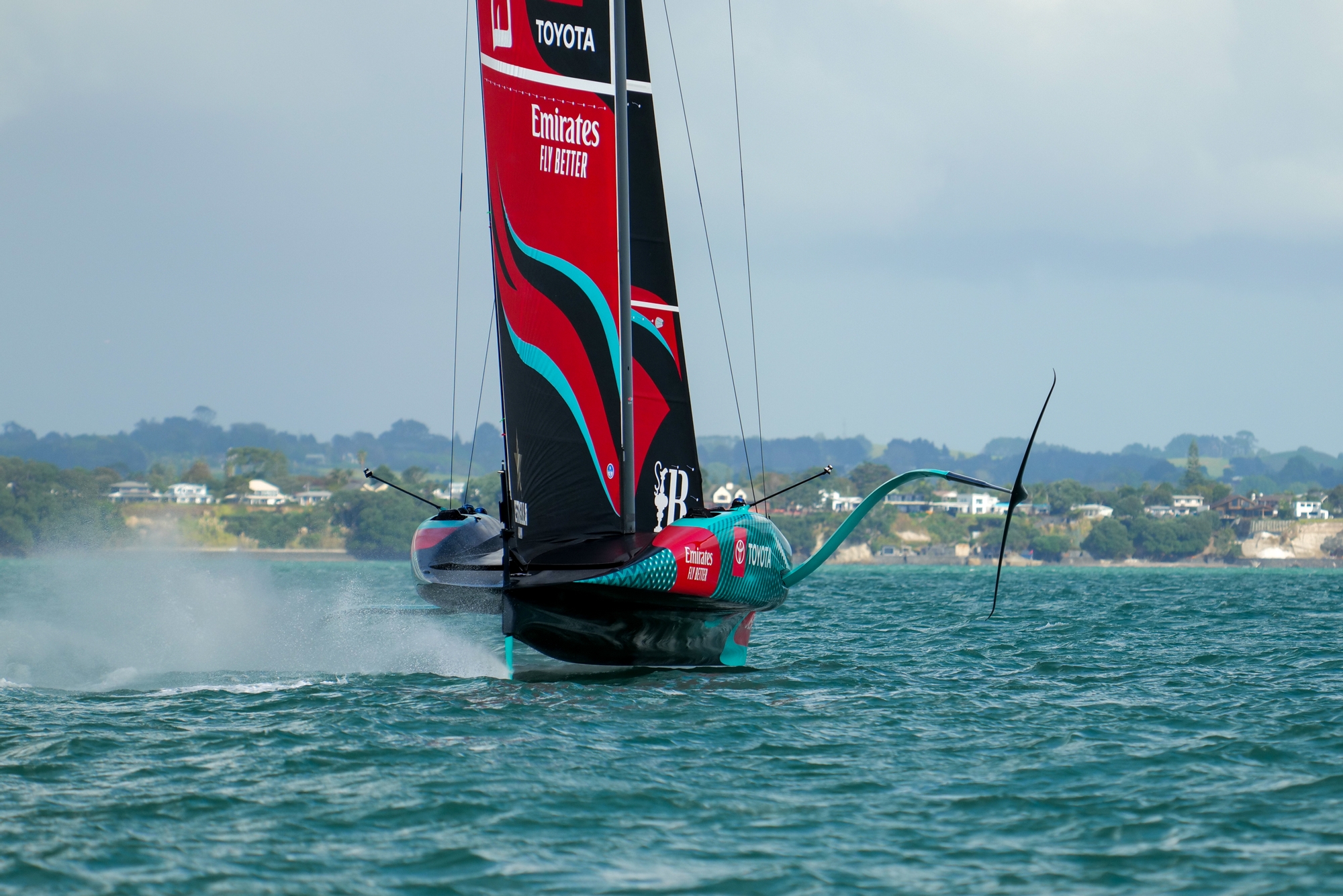
To see the new boat on the water is to witness smoothness personified, even at this early stage. Flight is low with the pitch dead flat, and some leaning into the immersed foil. This look like an easier, more forgiving boat to sail than the first generation AC75s, even without the race foils that will come onstream at a later date much nearer the competition – design powder is being kept resolutely dry all over this America’s Cup. In essence it is all about performance and outright speed at this stage, but the legacy foil package still delivered easy manoeuvres through the tacks that we saw and at a tight angle with a very low ride to the surface.
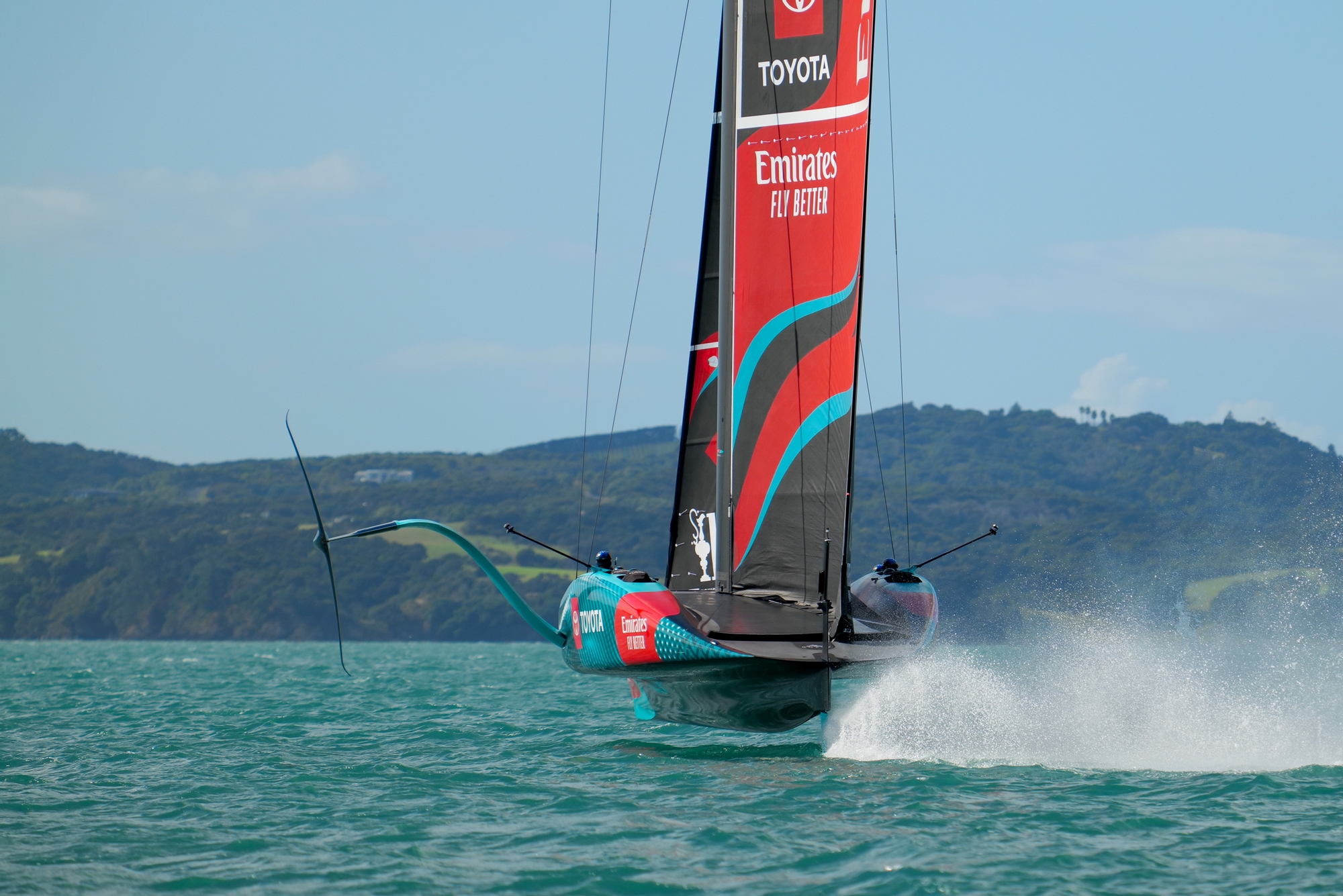
The ‘Back Paddock’ was certainly doing its part today with the breeze steady at 12-17 knots through what was a busy late summer afternoon and flat water – perfect for running through the delivery check list. Watching take-off at the lighter end of the scale it’s interesting to observe the bustle at work with the hull flaring sitting well above the water as the speed builds through the skeg. Once up, the boat almost looks to be squat, flying low with its aft profile hunkered down and the fine-entry bow just skimming the surface on its stepped chine. This boat exudes power all over without drama but the first bear-away at pace was a nervy affair that perhaps alluded to the foil profile not being AC37 design and a legacy from the last Cup.
Speaking afterwards, Dan Bernasconi, always a great commentator on the design aspects as Chief Technical Officer of Emirates Team New Zealand spoke about the approach to this new boat, saying: “We've always, always tried to be aggressive. I guess there's not many people on the team who take a conservative attitude to it. So yeah, we all pretty much always have gone all out. And same with this boat, I think there's a few areas where you have to make compromises and trade-offs, but you know ultimately, you're always going for the highest performance.”
Speaking about the reveal of Alinghi Red Bull racing and the launch of Luna Rossa Prada Pirelli yesterday, Dan gave his view saying: “They both look like really good boats. You can look at their boats and see that they've gone through all the same sorts of questions as we have, and come to slightly different conclusions in some areas, but they're not massively different. There's probably going to be more performance difference in the foils and then in the sails and the way the sails are controlled than there will be in the hull shapes. Obviously, the aerodynamics of the hull is important, but I suspect all teams have got to within a few seconds of each other around a racetrack, if all other things are equal.”
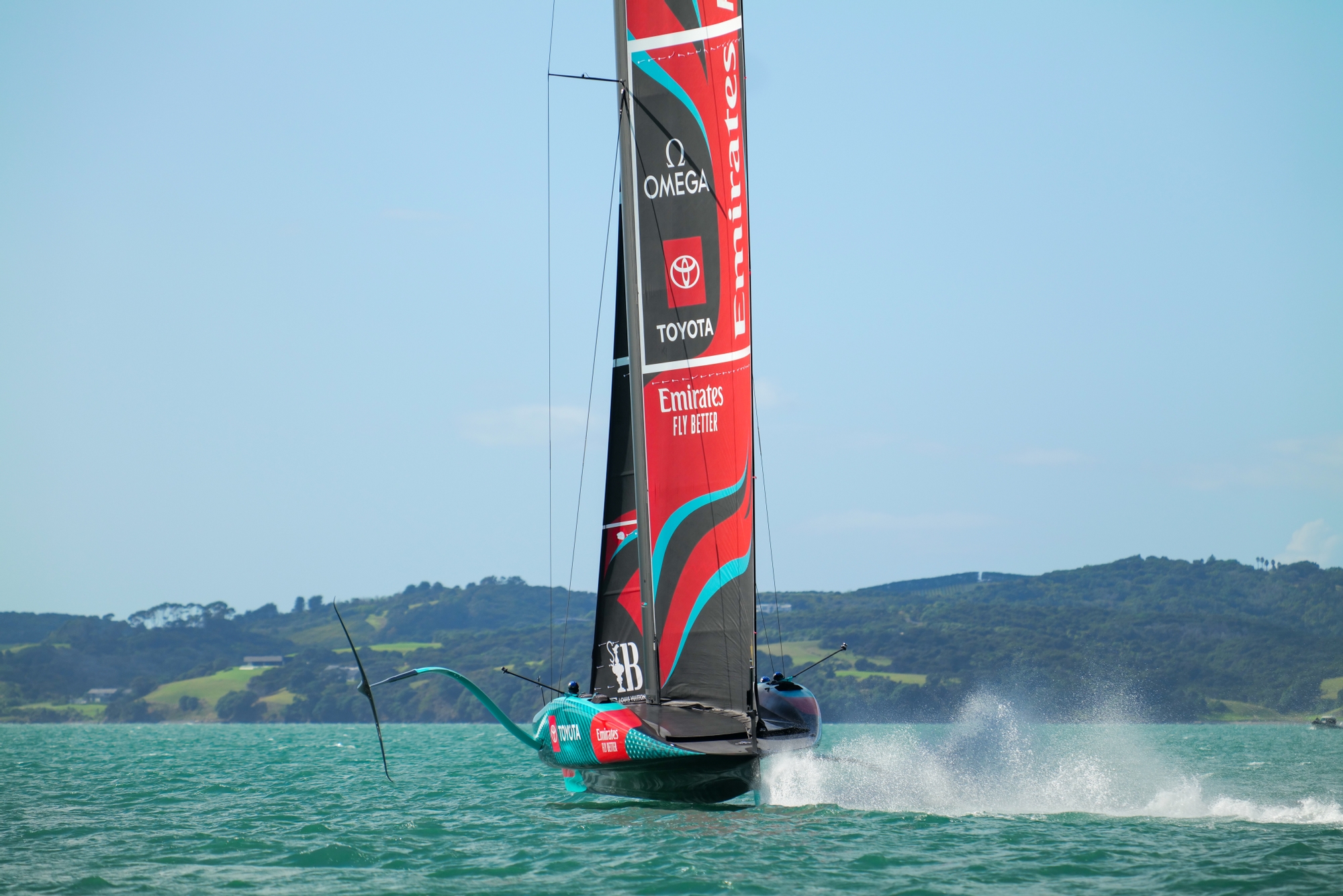
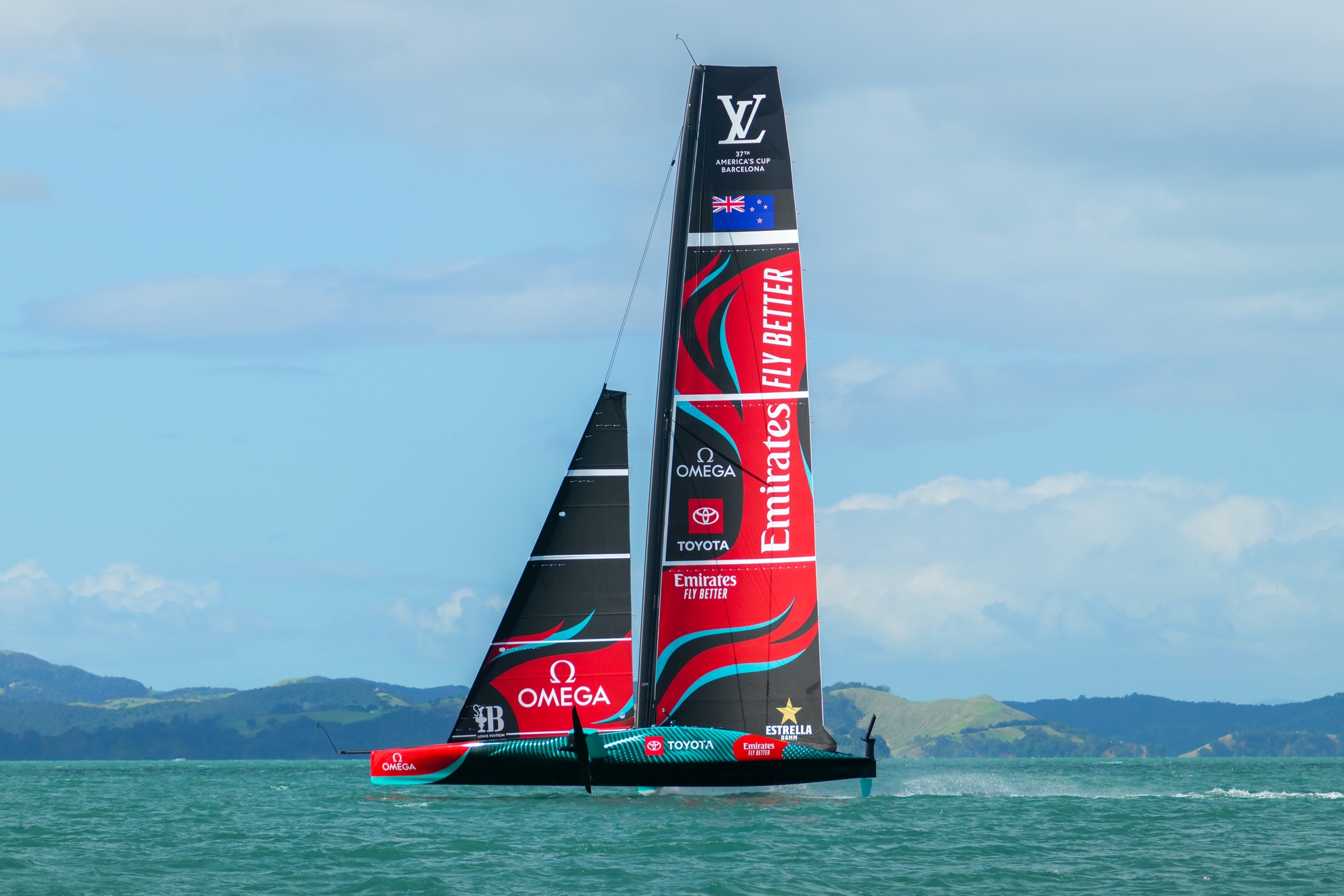
Noting the super low ride of the new Kiwi boat, the recon team asked whether this was all about the end-plating effect and Dan confirmed as such saying: “I think, that's mostly what it's about. It's about sort of creating the most efficient end plate if you like, for the sails and sort of extending them down to the water as much as possible. The take-off is a consideration and Barcelona is light, generally, and the waves don't help so both sides of the of that equation come into play and optimising the hull shape and the hydrodynamics and the aerodynamics but generally, I guess everyone's expecting to be foiling most of the time, so the aerodynamics are a bigger consideration.”
Day two of the new boat programme came to a conclusion in the late afternoon with dock-in at 3.35pm. Impressive straight-out-of-the-box performance, this boat will only get faster from here. (Magnus Wheatley)
On-Water Recon Report – Emirates Team New Zealand: Day 2 for the Emirates Team New Zealand new boat, out on the Hauraki Gulf started with some rain showers, and the team rolling the boat out of the shed at 9:30am to start the set-up and get ready for the boat's first full sailing day on the schedule. Recon observed some small hydraulic control issues being addressed around the base of the mast both in the cradle and on the dock. After a small delay on the dock, the team departed just before 12:00pm heading towards the ‘Back Paddock’ to find some clear space on a busy Sunday.
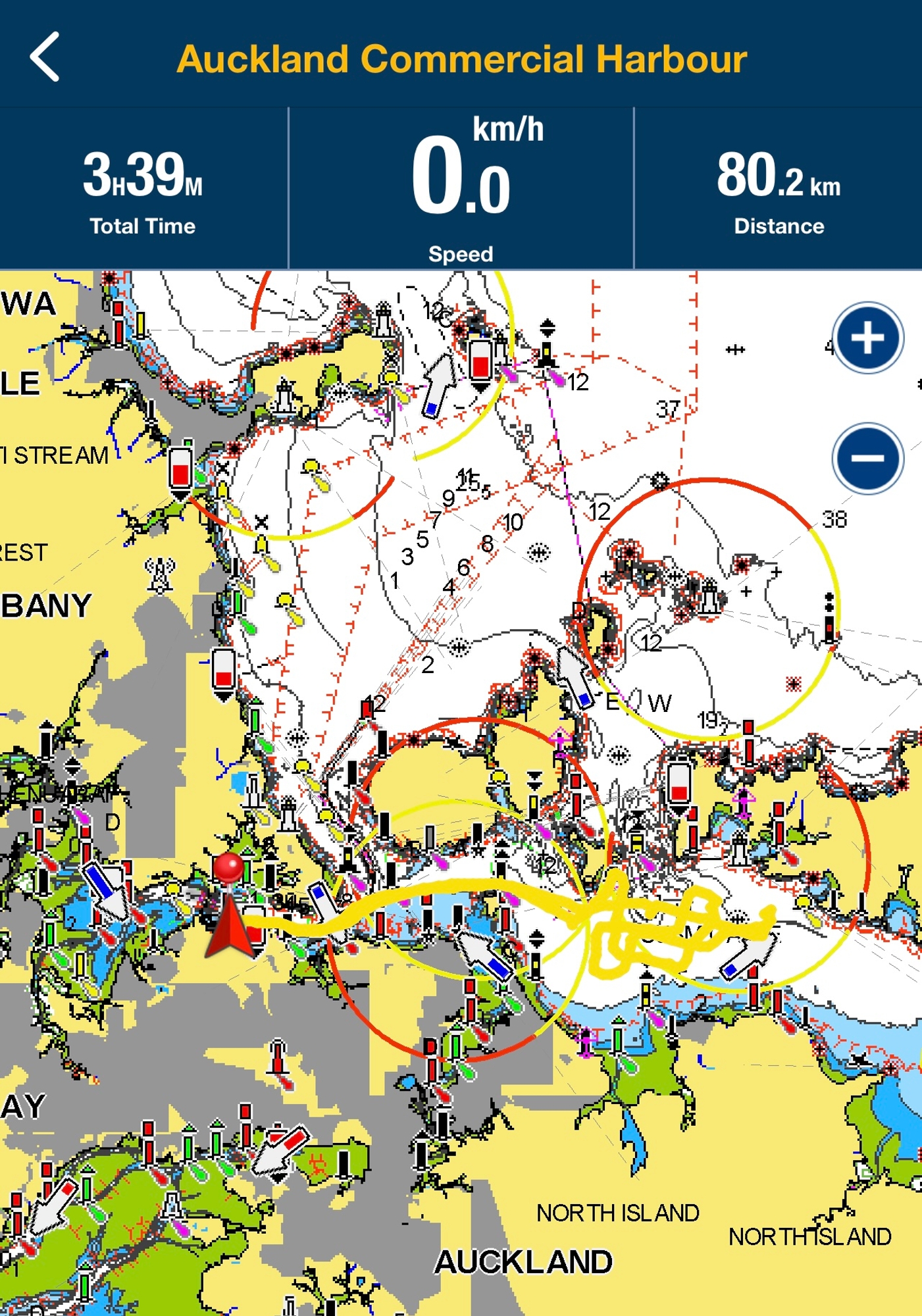
Coming off the tow, east of Browns Island, the team started getting ready for a main hoist. Recon observed some of the shore team working in the same area around the mast as they had been doing on the dock, possibly having ongoing issues in this area. Just as the mainsail skins started to get the heads plugged in, this process was halted, and Chase 2 was seen heading back to base. Recon later found out that one of the elements for the main control system had been left at the base. After about 40 minutes, the M2 Mains and the J4 Jib were hoisted, and the team started about 15 minutes after this.
Starting out on starboard tack, the team got the boat up and flying with good control. Sailing upwind, Recon was having to match speeds of around 38 knots to keep up. The team can be seen flying the boat very low to the water. Staying on starboard, the team completed the new boat’s first bear-away, which wasn't as smooth as previously witnessed manoeuvres. Sailing now downwind, the team started manoeuvring through gybes, showing good control, and systems seemed to be working as they should.
Rounding up as they started to run out of water, the boat came to a stop, and Chase 1 came alongside. Recon observed the J4 being dropped, and some adjustments being made. The team got back into sailing and proceeded to sail upwind, tacking back towards the mainland, then running back towards the islands and rounding up again down near the Passage Rock channel. Coming to a stop again, they called for a grinder change.
With the change complete after roughly about a 20-minute break, the team started sailing upwind again, tacking their way back towards Browns Island, sailing for approximately another 20 minutes, then coming to a stop and starting the pack-up procedure around 3:00pm.